






















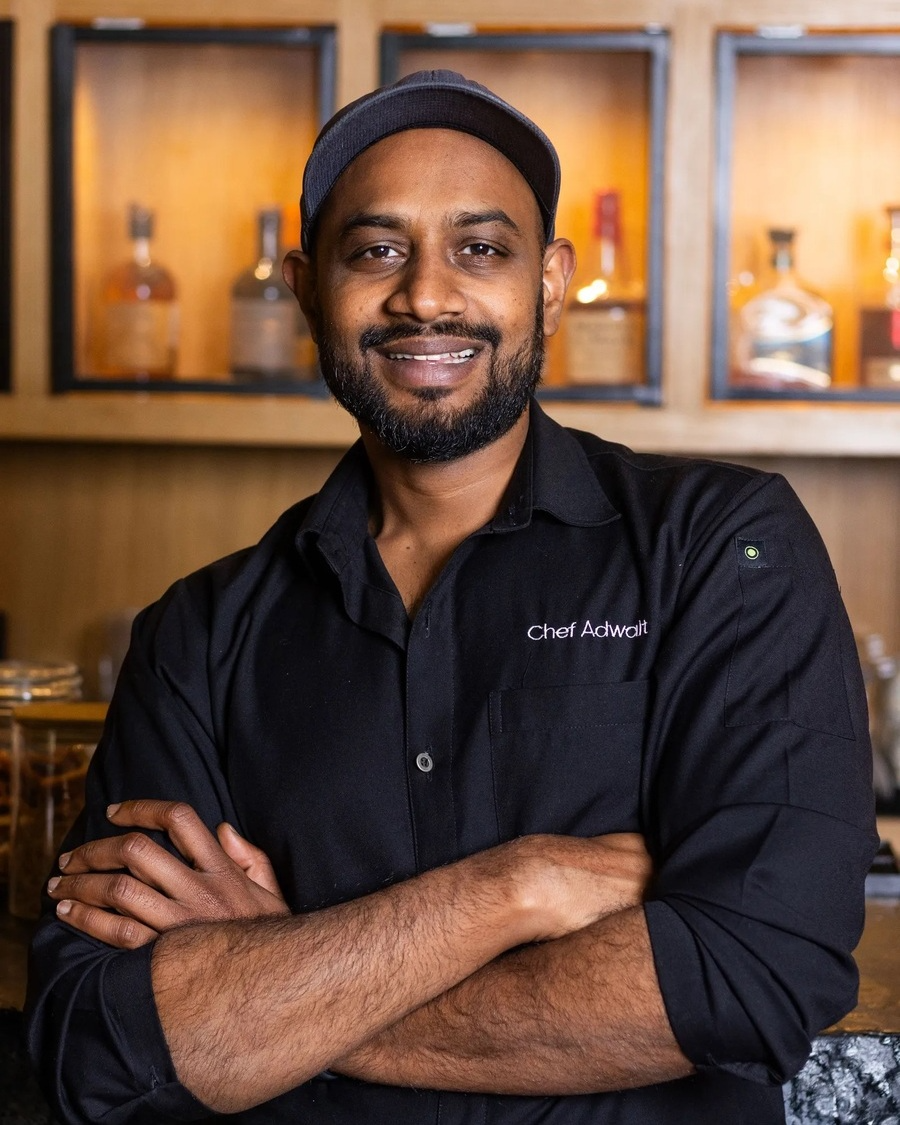
ADWAIT, LET’S START AT THE BEGINNING- WHAT FIRST DREW YOU TO THE KITCHEN? WAS THERE A PARTICULAR MOMENT. A FAMILY INFLUENCE, A MENTOR WHO TOOK YOU UNDER THEIR WING, OR EVEN A SPECIFIC DISH THAT SPARKED YOUR PASSION FOR COOKING AND MADE YOU REALIZE THIS WAS MORE THAN JUST A JOB. BUT A CALLING?
I think I’ve always been intrigued by cooking. In my family, especially on my mother’s side, there are a lot of family members who love to cook. My grandmother, my mom, both of her sisters and even my mom’s brother were all great cooks so I guess you could say it runs in the genes. When I was younger I used to stand next to my mom in the kitchen and just watch what she was doing. In India when we cook we often add mustard seeds to hot oil at the beginning. Somehow my instincts would tell me the exact moment they were about to crackle. It always felt very natural to me, almost like cooking was something I just understood instinctively. Growing up I also found myself choosing cooking shows over cartoons most of the time. So I guess that probably influenced me as well and helped shape my interest in cooking.
YOUR PATH EVENTUALLY LED TO CREATING INJA, A BOLD JAPANESE-INDIAN FUSION CONCEPT THAT IS RELATIVELY UNEXPLORED IN DELHI’S DINING LANDSCAPE. WALK US THROUGH THAT JOURNEY-WHERE DID YOU TRAIN IN THESE TWO DISTINCT CULINARY TRADITIONS, WHAT EXPERIENCES SHAPED YOUR UNDERSTANDING OF BOTH, AND WHAT WAS THE PIVOTAL ‘AHA MOMENT’ THAT MADE YOU BELIEVE THIS FUSION COULD NOT ONLY WORK, BUT TRULY RESONATE WITH DINERS?
I think there are two aspects to why I decided to work with Japanese cuisine. First of all, I had never actually been trained in Japanese food. I had never worked in a Japanese restaurant, never worked with a Japanese chef and I had not even been to Japan. One of the reasons goes back to my childhood. Growing up I was compared a lot. In the part of the world we come from there is always comparison with friends and cousins. Someone is getting into a better college, someone is scoring more marks and later someone is getting a better job or a higher salary. Of course parents want us to do better but I always hated being compared. So when I realized that I wanted to become a chef I also knew that I wanted to do something that had never been done before. The second thing that really triggered this idea was when I became very intrigued by Nikkei cuisine. About three and a half years into my career I started learning more about it. Nikkei cuisine is a mix of Peruvian and Japanese food. I was actually hoping to work at a Nikkei restaurant in Dubai but that did not work out. Even so I kept studying it and thinking about it. Seeing how two very different cultures like Peru and Japan could come together so organically made me wonder why Indian and Japanese cuisines could not do the same. My base was always Indian cuisine and I wanted to stay connected to that. At the same time I wanted to create something different, something that had never really been done before. Professionally I have never been trained in Japanese food. I actually started out as an Indian chef in Dubai. At that time I was looking to work in a modern Indian restaurant. Dubai\ is such a multicultural city with restaurants from all kinds of cuisines and I think that really helped shape my thought process. Being surrounded by so many amazing restaurants exposed me to a lot of different ideas. For me working with food is a lot like creating music. I often say that because I come from a family that has a strong connection with music. If you think about it, when someone wants to play rock music today they do not need to go back to the original rock era to learn it. In a similar way I feel it is the same with food. If I want to cook Japanese food I do not necessarily have to go to Japan to learn it. There is so much knowledge available today and if you develop a real sense and understanding of a cuisine it becomes possible to cook it even without being there. So professionally I have never trained or worked in Japanese cuisine but I was still able to explore and learn about it in my own way.
JAPANESE AND INDIAN CUISINES BOTH HAVE DEEP, ANCIENT TRADITIONS, YET THEY SIT AT ALMOST OPPOSITE ENDS OF THE CULINARY SPECTRUM IN TERMS OF TECHNIQUE, PHILOSOPHY, AND FLAVOR. WHAT WAS THE ORIGINAL VISION BEHIND INJA WHEN YOU FIRST CONCEIVED IT, AND HOW DO YOU PERSONALLY DEFINE THIS UNIQUE CULINARY MARRIAGE-DO YOU SEE IT AS A DIALOGUE. A COLLABORATION. OR SOMETHING ELSE ENTIRELY?
To be very honest I do not think there is one thing that can clearly define the kind of cuisine I do. There is no fixed thought process behind it. Just like in a person’s life, things keep evolving. When we first started I had a certain philosophy. After a year it changed. After two years it changed even more and after three years it became a little different again. That is natural because we all humans are products of evolution and the way we think keeps changing over time. So I would say the cuisine itself is constantly evolving. Even now I am still trying to understand what the real thought process behind Indian and Japanese cuisine together could be. But if I had to set a baseline, it is really about bringing the sensibilities of both cuisines together. It is not simply about taking an Indian ingredient and applying a Japanese technique or taking a Japanese ingredient and applying an Indian technique. If that was the case we would just be doing things like butter chicken sushi, which is not what we are trying to do. It is more about understanding the cultural references, the eating habits and the way similar ingredients are used in both cultures. For example in west Bengal there is a dish called panta bhat, which is basically overnight fermented rice that is often eaten for breakfast. In Japan rice is also a very important part of breakfast, even though it is not fermented in the same way. When I noticed that both cultures have this idea of eating rice in the morning, I found a common ground between them. So a dish can come together by connecting those cultural habits rather than forcing two things together. Indian and Japanese cuisines may seem like complete opposites but there is always a way to bring two different cultures together in a thoughtful and sensible way.
FUSION CUISINE CAN SOMETIMES FEEL FORCED OR GIMMICKY WHEN NOT EXECUTED THOUGHTFULLY. HOW DO YOU ENSURE THAT EVERY DISH AT INJA FEELS LIKE A NATURAL, RESPECTFUL CONVERSATION BETWEEN JAPANESE AND INDIAN CULINARY TRADITIONS RATHER THAN A RANDOM COLLISION OF INGREDIENTS ON A PLATE? WHAT IS YOUR LITMUS TEST FOR AUTHENTICITY?
Yes, I mean you are absolutely right about fusion cuisine. And to be very honest there is no litmus test for it. There is no SOP and there are no fixed steps that I follow to decide whether a dish qualifies or does not qualify. For me it is more about the overall feel of the dish. Whenever I create something it is never a 50-50 mix of Indian and Japanese. It is more about references, like I mentioned earlier. It could be a reference to certain ingredients or the way an ingredient is treated in a particular cuisine. The important thing is to treat the ingredients with respect and to make sure the idea makes technical sense and pays respect to the craft. There is really no strict rule or formula to it. I would say the only real test is how the dish feels to me. If I like the idea of it, if I like the sound of it, if it looks good, tastes good and also makes sense technically, then it earns its place on the menu, because there were certain dishes which were good but never made it to the final menu as they didn’t give the right feeling.
SOME OF YOUR TECHNIQUES MUST CREATE FASCINATING CROSSOVERS-TATAKI MEETING THE TANDOOR, MISO GLAZES MEETING MUSTARD SEED TEMPERING, OR DASHI BUILDING BLOCKS MEETING INDIAN STOCK PREPARATIONS. WHAT HAS BEEN YOUR MOST SURPRISING OR SUCCESSFUL TECHNIQUE CROSSOVER TO DATE, AND CONVERSELY, WHAT COMBINATION REQUIRED THE MOST PERSISTENCE, TRIAL AND ERROR, AND REFINEMENT BEFORE IT FINALLY WORKED?
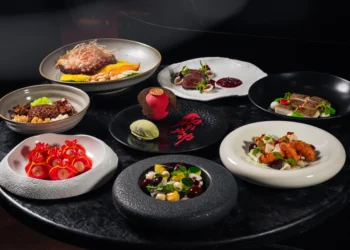
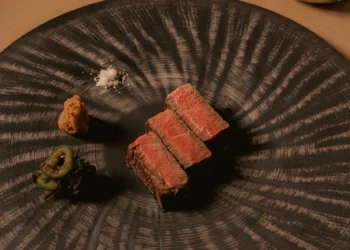
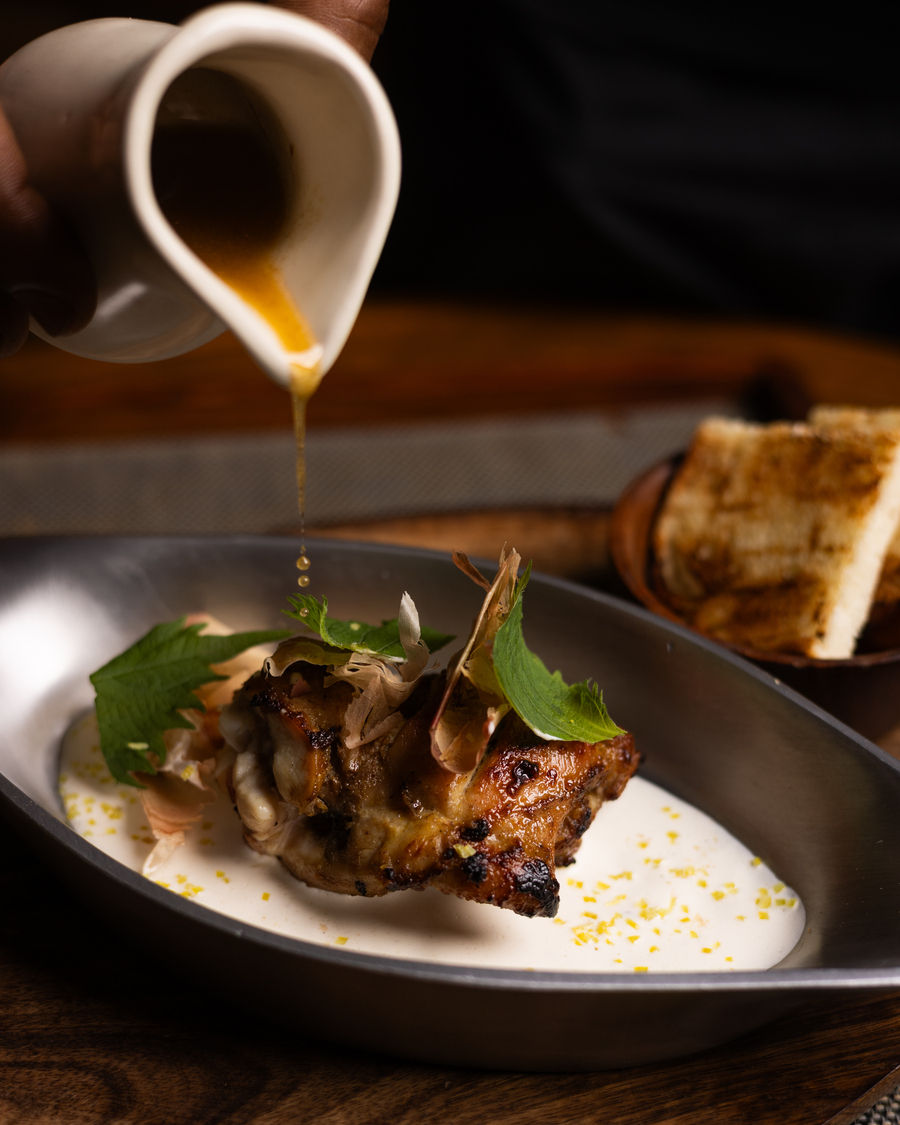
I can give you two examples from the menu that explain how we approach ideas and techniques. Technique based – One of them is a dish called Banana Bonito which appears in our tasting menu. There is a bread course inspired by Mangalorean buns. These are deep fried breads from Mangalore where the dough is made with overripe bananas and fermented overnight. Traditionally they are eaten for breakfast with a spicy curry and a cup of filter coffee. We took this breakfast plate from Mangalore and reimagined it as a bread course. We make Mangalorean buns using ripe bananas, but instead of serving them with the traditional curry we convert that idea into a sago curry butter. Along with this we serve something called Banana Bonito. The idea comes from katsuobushi, which is made from skipjack tuna that is fermented, smoked and dried over a long period of time until it becomes extremely hard and is then shaved into thin flakes. We take that same technique and apply it to ripe banana. The bananas are brushed with palm sugar and then slowly smoked and dehydrated multiple times. Over time the banana becomes very firm, almost like a piece of wood. At the end we shave it on a katsuobushi slicer just like bonito. What you get are delicate shavings of sweet, smoky, caramelised banana which almost feel like a candy, and we serve that with the bread course. Another example is Yuzu Kosho with freshly grated coconut. We marinate our shrimps in this and simply grill them and finish off the dish with some shrimp head oil where flavours work beautifully. I would also like to mention the Koji chicken wings, here we have created a Teriyaki sauce with Indian ingredients like – Tamarind and Jaggery and we finish the wings with some smoked Kashmiri chilli powder.
INJA IS CARVING OUT AN ENTIRELY NEW NICHE IN DELHI’S COMPETITIVE DINING SCENE, ONE THAT COULD INFLUENCE HOW FUTURE CHEFS APPROACH CROSS- CULTURAL CUISINE IN INDIA. WHERE DO YOU SEE JAPANESE-INDIAN FUSION EVOLVING OVER THE NEXT DECADE IN THIS COUNTRY, AND WHAT LEGACY DO YOU HOPE INJA LEAVES BEHIND-NOT JUST AS A RESTAURANT, BUT AS A PHILOSOPHY THAT INSPIRES THE NEXT GENERATION OF CULINARY INNOVATORS?
I am really happy that you asked this question because it takes me back to when we first started. To be honest I was always a little afraid that we might have to shut the restaurant within six months. Indian Japanese cuisine had never really been explored seriously or at all, so I did not know if people would understand it or connect with it. Somehow we managed to make it work. Of course we worked very hard for it. Not just the kitchen team but also the service team played a huge role. They were always on top of things, patiently explaining the dishes and the whole concept to the guests. Sometimes my ideas can be a little abstract to explain, but they have done a beautiful job translating that to the diners. I also have to say that doing Indian Japanese cuisine is not easy. For me it felt difficult in the beginning because there was no real reference point. I was figuring things out as I went along. But I genuinely hope that more young chefs and students get inspired by it and start exploring this space further. In fact it would make me very happy if more chefs started doing their own interpretations f Indian Japanese cuisine. It is always a compliment when people take inspiration from something you started and try to take it forward in their own way. That is how cuisines evolve. If I look at the broader dining scene in India, when I was studying, there were not many people who were actually interested in Japanese cuisine, including myself. Most people were working in European kitchens. But things are slowly changing now. After the wave of Korean food, I feel Japanese cuisine is starting to gain a lot more attention. There is also a lot more cultural and business exchange happening between India and Japan. The Japanese government has been investing in collaborations and partnerships, and more Japanese people are coming to India while more Indians are travelling to Japan as well. Over the last few years people here have started understanding Japanese food much better. Because of that I really hope that culinary schools and hotel management institutes in India start introducing Japanese cuisine more seriously into their curriculum. When I was studying we only had one day dedicated to Japanese food and it was mostly limited to sushi and rolls. There is so much more depth to it, and I think the next generation of chefs would really benefit from learning about it properly. It would be fascinating to see how the next generation interprets and carries forward Indian-Japanese cuisine. What excites me most is the idea that everyone brings their own perspective to food, and you never quite know what new and inspiring ideas might emerge from that process. If that happens, I imagine I would feel two things. First, a quiet sense of gratitude if my work helped spark curiosity or encouraged others to explore this space. And second, genuine excitement in seeing the cuisine through fresh eyes – discovering interpretations and possibilities that I may never have considered myself, and of course this is compliment to all the work we do here at INJA and the creative person inside me.