


















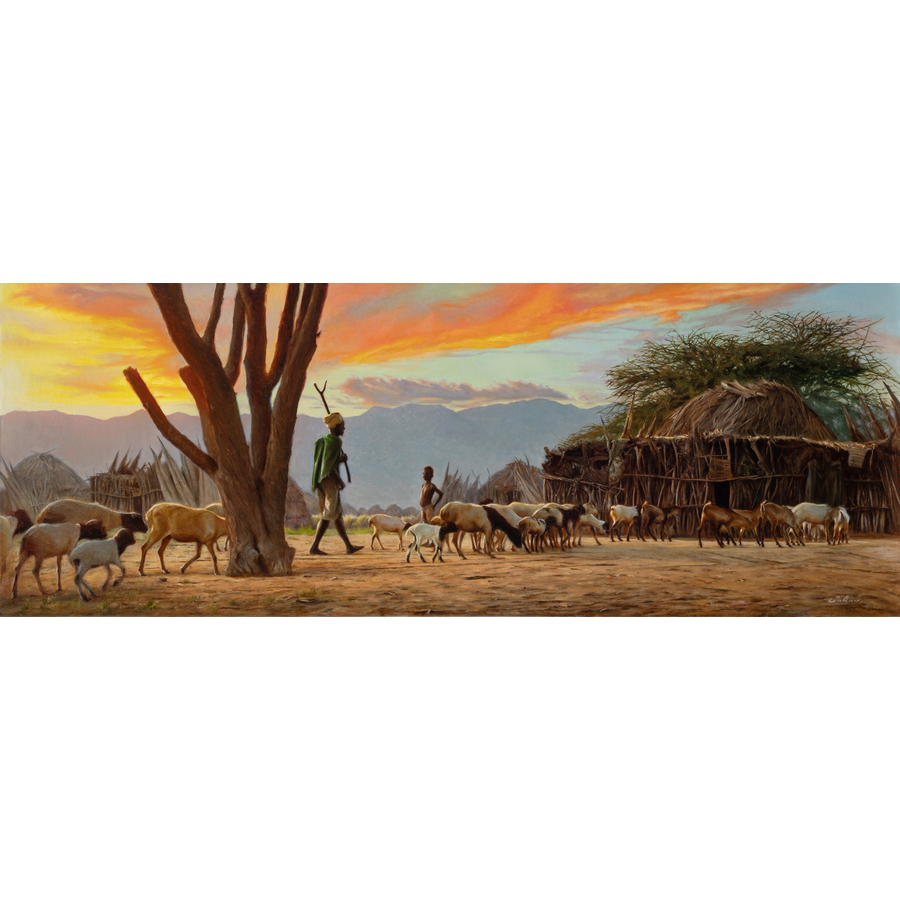
YOU’VE MADE TWO SEPARATE EXPEDITIONS TO THE OMO VALLEY – OCTOBER 2022, THEN MAY 2024. MOST ARTISTS SPEND YEARS WORKING FROM REFERENCE AND NEVER LEAVE THEIR STUDIO. WHAT WAS THE CONVICTION THAT MADE YOU DECIDE THAT LIVING WITH THESE TRIBES WAS NOT JUST WORTHWHILE, BUT ABSOLUTELY NECESSARY TO THE WORK?
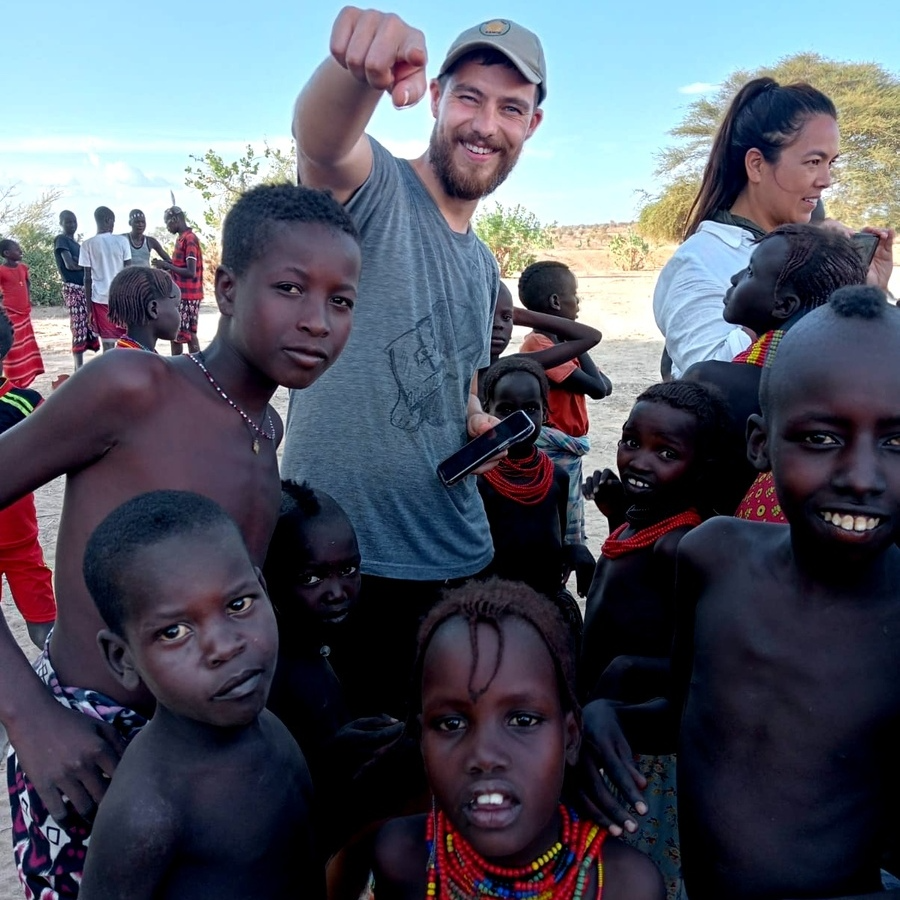
For me, travelling and experiencing places, people, and cultures different from my own has always been at the core of my interests. Because I was deeply interested in these tribes – curious about how they live, their traditions, rituals, struggles, and daily routines – I could never imagine painting them from Google images or other people’s references.
For me, if you want to tell somebody’s story, you have to earn the right to do so. That means experiencing what they experience, living alongside them, speaking with them, and learning their personal stories firsthand. I feel the same way about painting landscapes. If you want to paint a place, g there and find your own unique angle on it. When you are immersed in an experience you will find that what grabs your attention is different from other artists, and that is what makes your perspective unique. When you paint from other people’s reference, you are reacting to what they found interesting.
When you stay with people for extended periods of time, you begin to separate the tourist or outsider perception from what is actually real. For example, some tribes closer to the main roads or villages have become accustomed to photographers visiting, and sometimes people may wear things specifically because they know photographers find them visually interesting – flowers, skulls, certain adornments even when these things are not authentic.
You would never understand those nuances sitting at home. That’s why we travelled further and further away to villages that receive very few visitors, because I wanted to experience something closer to their real way of life.
I also think there is something important about experiencing the daily realities alongside people, even
if only in a small way. Living there, dealing with the health issues, the discomfort, nature (scorpions inside your tent, hyenas chewing your tent at night, etc) – experiencing some fraction of what daily life demands from them – brings you closer to their mindset and gives you an understanding of them as people rather than subjects.
THE OMO VALLEY IS HOME TO MANY TRIBES, YET YOU SOUGHT OUT EIGHT VERY SPECIFIC COMMUNITIES – THE SURI, ARBORI, DASSENICH, MURSI, BODI, HAMAR, NYANGATOM, AND KARO. WHAT DISTINGUISHED THESE PARTICULAR TRIBES FROM OTHERS IN THE REGION, AND HOW DID YOUR GUIDES MAKE ACCESS TO
COMMUNITIES THIS REMOTE EVEN POSSIBLE?
There are many tribes throughout the Omo Valley, but many communities today interact much more with the outside world and broader society than others. While they still maintain important cultural traditions, my interest was specifically in communities that remain more geographically isolated and have much less regular outside contact.
That influenced not only which tribes we chose, but also which specific villages we visited. We intentionally travelled to villages that were further away and much less frequently visited by outsiders.
Access to these communities depends almost entirely on relationships. Our guides were extraordinary people often individuals who were born within tribal communities themselves, later learned English, and spent decades building trust and working with these regions. Some had previously guided major expeditions and photographers, including people like Steve McCurry.
Because each tribe often speaks a different language, the process becomes even more layered. While our primary guides spoke many local languages, for each tribe we would often bring in a
local guide from that specific community or region somebody known personally by the people there and able to communicate at a much deeper level.
SIX TO TWELVE HOURS FROM THE NEAREST HOSPITAL, NO REFRIGERATION, NO SHOWERS, GUNS FIRED AT WILL, FOOD POISONING, A LUNG INFECTION – YOU PAINT A PICTURE OF CONDITIONS THAT WOULD DETER MOST TRAVELLERS. LET ALONE ARTISTS CARRYING CANVASES. CAN YOU WALK US THROUGH WHAT A TYPICAL DAY IN THE FIELD ACTUALLY LOOKED AND FELT LIKE?
A typical day almost didn’t exist, because life in the field was constantly shaped by obstacles, opportunities, and whatever happened around us.
On our second trip, for example, there were times when we couldn’t even reach certain tribes because bridges had collapsed from heavy rainfall or roads were completely flooded. Other days, plans would suddenly change because news would arrive that a nearby village was holding a ceremony, a marriage, or a coming-of-age ritual, and the guides would say, “We need to go now.”
But on days without disasters or unexpected changes, there was still a rhythm to life.
We slept in tents and usually woke around 6 a.m., mostly because the villages woke up – goats making noise, children running around, animals everywhere, and the sun already rising. We would have breakfast prepared by the camp chef using whatever ingredients were available despite having no refrigeration or infrastructure, and then discuss with the guides what paintings or photographic work we wanted to make that day.
YOU WERE THE ONLY PAINTER IN A GROUP OTHERWISE MADE UP OF PHOTOGRAPHERS. CAMERAS ARE FAST; PAINTING IS SLOW AND EXPOSED. HOW DID YOUR PROLONGED PHYSICAL PRESENCE IN FRONT OF A SUBJECT – BRUSH IN HAND, CANVAS OPEN – CHANGE THE QUALITY OF CONTACT YOU WERE ABLE TO MAKE WITH THE PEOPLE YOU WERE PAINTING?
In some ways, painting people rather than simply photographing them felt more personal and less transactional, but it also created its own difficulties.
Many people had never really encountered somebody painting before, so there was sometimes confusion about what I was doing or why. And, understandably, sitting still for two or three hours is not something most people enjoy.
I discovered this almost immediately during my first trip with the first tribe I visited, the Suri. I wanted to paint a woman from life who was wearing an enormous triangular clay lip plate These lip plates are associated with beauty, status, and elegance, although they are often worn more commonly during ceremonies or special occasions rather than continuously.
What I quickly discovered was that painting and photography create completely different problems. After about fifteen minutes, she removed the lip plate because it was simply too heavy and uncomfortable to wear continuously. But once it came out, the entire structure of the face changed muscles relaxed, the lip dangled down (as opposed to being stretched around the lip plate), everything shifted. So suddenly the painting became this negotiation where every so often I would ask if she could put it back in briefly so I could be reminded how the face muscles looked when the plate was in.
YOU’VE SAID EACH TRIBE IS ENTIRELY DISTINCT. YET THAT OVERLAPPING TRADITIONS EXIST BETWEEN THEM. AFTER TWO MONTHS ACROSS EIGHT COMMUNITIES, WHAT WERE THE RITUALS, CEREMONIES, OR MOMENTS OF DAILY LIFE THAT STOPPED YOU COMPLETELY – THE THINGS THAT FELT IMPOSSIBLE TO FULLY ABSORB IN THE MOMENT?
There were many moments that were difficult to fully absorb while they were happening, but if I had to choose one experience that stayed with me most, it would probably be witnessing a donga stick fight with the Suri during our first trip.
Donga is a competitive stick-fighting tradition between men from different villages within the same tribe. Calling it a sporting event almost feels too simple because the atmosphere around it is extraordinary. Hundreds of people gather in an open field, everyone surrounds the fighters, there is excitement everywhere, and matches are announced by men firing AK-47s into the air.
Then the fighting begins. The men strike each other incredibly hard using long sticks while defending themselves with small shields. They wear protective coverings made from plants on their heads and shins because injuries are common and the strikes are powerful enough to cause serious damage.
ON THE VERY FIRST NIGHT OF YOUR 2022 TRIP, YOU ENTERED THE MURSI CAMP HOURS AFTER A MAN HAD KILLED ANOTHER IN AN ACT OF REVENGE – AN ACT ELEVEN YEARS IN THE MAKING, AND ONE THAT A VILLAGE ELDER’S PEACE NEGOTIATION HAD TRIED TO PREVENT. WHAT DOES AN EXPERIENCE LIKE THAT. ARRIVING INTO THAT SPECIFIC ATMOSPHERE ON YOUR FIRST NIGHT, DO TO THE WAY YOU APPROACH EVERYTHING THAT FOLLOWS?
When we arrived at the Mursi camp during our first expedition, we learned that a man had been killed earlier that same evening.
As it was explained to us, the story actually began more than a decade earlier. The man who had been killed had previously killed another man’s brother many years before. Traditionally, situations like this can sometimes be resolved through negotiations led by village elders, where compensation is agreed upon between families often involving cattle or other forms of restitution – and once an agreement is reached, the conflict is considered resolved and should not continue.
In this case, we were told that process never happened. So more than a decade later, the revenge finally came. What struck me was not simply the violence itself, but the time scale. The idea that something could remain unresolved for eleven years and still shape people’s lives so profoundly was difficult to comprehend coming from my own cultural background.
Arriving into that atmosphere on our first night changed the way I approached everything afterward.
It reminded me very quickly that we were not visiting some romanticized or frozen world – we were entering functioning societies with their own systems of justice, conflict, politics, grief, and social structures, many of which operated very differently from what I was used to.
At the same time, it also made me realize that we were observers rather than participants. These social structures governed life within the community itself; we were outsiders being allowed to witness them.
IN MAY 2024, YOU WITNESSED THE SHOOTING DEATH OF SPANISH PHOTOGRAPHER AND GUIDE TONY ESPADAS – SOMEONE WHO HAD DEVOTED HIMSELF TO THOSE COMMUNITIES AND WAS BELOVED BY THEM. THAT IS A TRAUMA OF AN ENTIRELY DIFFERENT ORDER. HOW DO YOU CARRY THAT, AND DO YOU BELIEVE IT HAS FOUND ITS WAY INTO THE WORK WAYS YOU MAY NOT HAVE FULLY INTENDED?
That day was certainly a shock because events took a turn that none of us could have imagined and resulted in us witnessing the aftermath of a shooting.
At the same time, I think it is important to emphasize that this was not normal. Incidents like this are extraordinarily rare, and the communities themselves understand that guides, visitors, and expeditions are important relationships that have existed for many years. Everyone was shocked- not only us
The response was immediate. The Ethiopian authorities brought in the army quickly, moved us to safety, and began pursuing those responsible almost immediately.
To be honest, though, the emotional experience was strange. This happened the day after the extremely difficult cattle sacrifice ceremony I mentioned earlier, and I think by that point I was already emotionally exhausted. During the event itself, we were also physically removed from what happened – we were several vehicles behind, so while people who were directly involved were understandably deeply shaken, our experience was more like witnessing a situation unfolding rather than being inside it.
TWO FURTHER PAINTINGS FROM THIS SERIES – REBUILDING THE HOME AND ARJAN ARBORO OF THE ARBORI TRIBE – HAVE ALSO RECEIVED MAJOR AWARDS. BOTH TITLES SUGGEST VERY DIFFERENT PAINTERLY INTENTIONS: ONE COMMUNAL AND ACTIVE, ONE SINGULAR AND STILL. CAN YOU TALK ABOUT WHAT EACH OF THOSE WORKS WAS TRYING TO DO, AND WHY YOU THINK THEY HAVE CONNECTED SO STRONGLY WITH AUDIENCES?
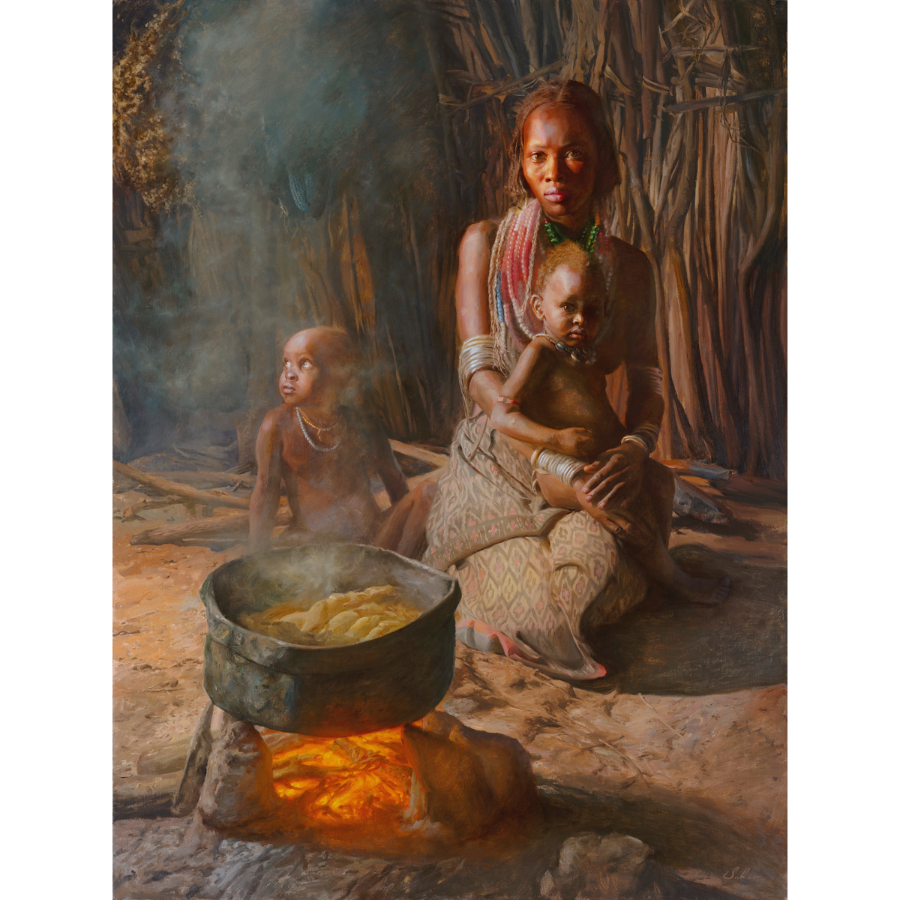
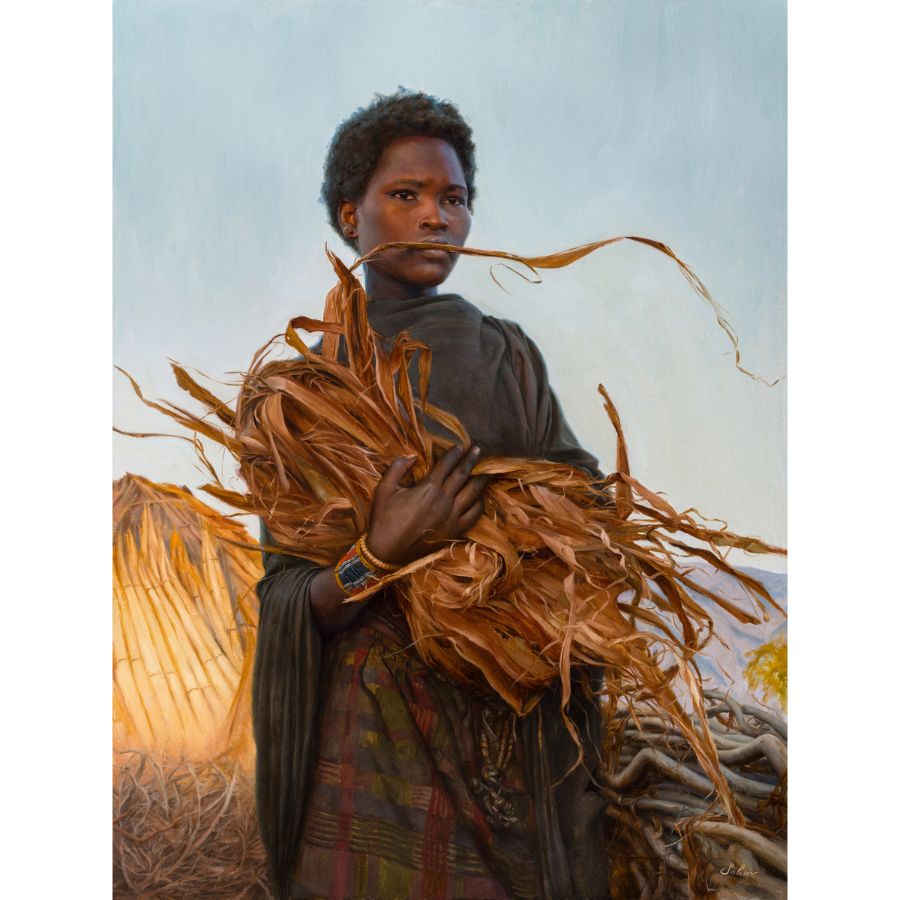
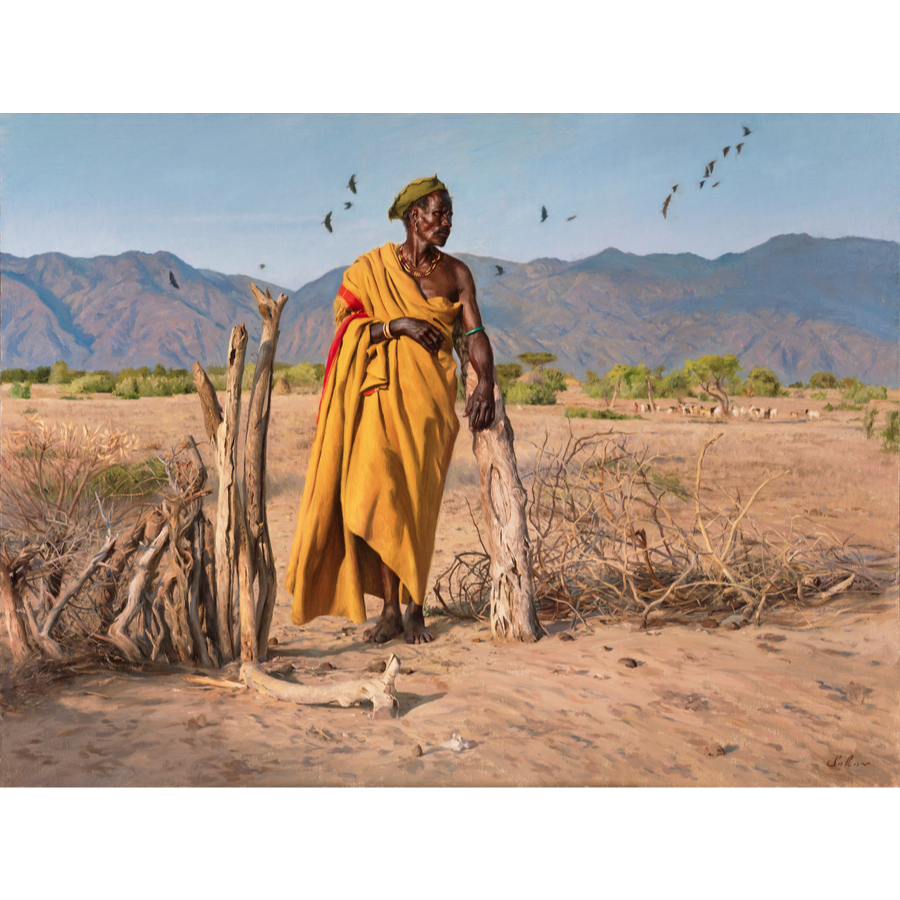
Rebuilding the Home and Arjan Arboro of the Arbore Tribe were the first two major paintings I completed from the series. Both are 40 by 30 inches, both depict members of the Arbore tribe, and both come from the same village, which is one reason I think of them as companion pieces.
They were also the first works from the project that received significant recognition, and at the time I felt they were the strongest paintings I had ever made. I was extremely proud of them.
Rebuilding the Home focuses on a young girl carrying strips of tree bark. What makes the scene meaningful is the purpose behind it. The homes in the village are built from natural materials that gradually deteriorate and must be rebuilt every eight to ten years. The bark she is carrying is used to bind and secure the new structure together. So although the painting appears simple at first glance, it is really about renewal, continuity, and the work required to sustain everyday life.
The scene was painted from an early morning moment, around 6:30 a.m., when the light had a distinctive greenish quality that I found incredibly beautiful. I wanted the painting to feel quiet and purposeful, reflecting the rhythm of daily life rather than a dramatic event.
Arjan Arboro of the Arbore Tribe had a very different goal. Arjan was an incredibly striking individual. He wore a bright yellow tunic unlike anything I saw on anyone else, and he seemed to possess a strong personal sense of style and presence. His face immediately caught my attention, but I didn’t want to paint him as an isolated portrait.
YOU PAINTED PEOPLE AND LANDSCAPES DIRECTLY FROM LIFE IN THE FIELD, AND ALSO PHOTOGRAPHED SUBJECTS TO DEVELOP LARGER, MORE COMPLEX WORKS THE STUDIO. THAT IS A VERY DELIBERATE TWO- TRACK PROCESS. WHAT DOES THE DIRECT, EN PLEIN AIR ENCOUNTER GIVE THE PAINT THAT NO PHOTOGRAPH – HOWEVER GOOD – CAN FULLY CARRY BACK?
Painting from life is a very special process, and in my opinion it gives something to a work that is difficult to achieve any other way.
In an ideal world, if I could somehow persuade people to hold complex poses for a hundred and twenty hours, I would paint everything from life But of course that isn’t possible. Many of the scenes that interested me in the Omo Valley were fleeting moments involving multiple figures, movement, and events that unfold over seconds rather than hours. A donga stick fight, fishermen working from boats, ceremonies, dances-those are situations where photography becomes essential.
For more intimate subjects, however, especially portraits, painting from life offers something entirely different. You spend time with the person. You observe them beyond a single expression.
You watch subtle changes in posture, mood, and light. The experience becomes less about recording appearance and more about understanding presence.
I feel this even more strongly when it comes to landscapes. For me, landscapes are best painted directly from life because the environment is constantly changing. During a single painting session, the light may shift completely, shadows move, clouds arrive, people appear and disappear from the scene. In one sense that is a challenge, because the subject never sits still. But it is also an opportunity because you begin noticing relationships and moments that no photograph would ever show you
YOU DESCRIBE YOUR RELATIONSHIP TO THIS SUBJECT AS AN OBSESSION – YOU HAVE PLANS FOR MORE TRIPS, AND REFERENCE MATERIAL YOU HAVEN’T YET TOUCHED. BUT OBSESSION IN AN ARTIST CAN MEAN MANY THINGS. IS THIS A PROJECT WITH AN END, OR HAVE THE OMO VALLEY TRIBES BECOME SOMETHING CLOSER TO A LIFELONG INQUIRY?
The Omo Valley tribes are special to me because they represent cultures with incredibly deep histories and traditions that have endured for a very long time. Ethiopia itself occupies a remarkable place in the story of human history and human evolution, which only adds to the sense that you are encountering something profoundly ancient.
I have developed a deep affection for the people I met there, and I certainly feel that I still have much more to paint from the material I gathered during my expeditions. There are paintings
I have not yet begun, stories I have not yet told, and ideas I am still excited to explore.
At the same time, I don’t think of myself as an Omo Valley painter. What really interests me is not a single place but the experience of encountering cultures different from my own and trying to understand them through painting. The Omo Valley happens to be one expression of that interest.
SOMEONE WALKS INTO A GALLERY AND STANDS IN FRONT OF ONE OF THESE PAINTINGS. THEY KNOW NOTHING ABOUT THE OMO VALLEY NOTHING ABOUT THE TRIBES, NOTHING ABOUT WHAT IT COST YOU TO BE THERE. WHAT DO YOU WANT TO HAPPEN IN THAT PERSON IN THE THIRTY SECONDS THEY SPEND LOOKING -AND WHAT WOULD IT MEAN TO YOU IF IT DID?
If somebody stands in front of one of these paintings and encounters a culture they have never thought about before, I hope the work creates a sense of wonder and curiosity. I hope it makes them want to learn more, ask questions, read about the people depicted, or perhaps even visit these places themselves.
For me, these paintings are ultimately a celebration of the incredible variety of human experience. Across the world, people have developed countless ways of living, believing, building communities, and understanding their place in the world. I find that diversity endlessly fascinating.
I think we live in a time when many parts of the world are becoming increasingly interconnected and, in some ways, more culturally homogeneous. While there are many positive aspects to that, I also believe there is value in recognizing, preserving, and appreciating traditions that have developed along different paths.
If a viewer spends thirty seconds with one of my paintings and leaves feeling a little more curious about people unlike themselves, then I would consider the painting successful.
Pavel Sokov’s paintings from the Ethiopian Tribes series are available through the artist directly at pavelsokov.com. His Best in Show work will be featured at Sotheby’s New York on July 17th as part of the Art Renewal Center’s 17th Annual Salon auction.