


















The Painter Who Invented a Colour
Turn off Marrakech’s western boulevards and the city softens. Traffic gives way to palms, dust to jasmine, and the ochre walls take on first at a distance, then everywhere an impossible shade of blue. The locals simply call it Majorelle Blue, and the story of why is the story of two men who never met, and the garden they came to share.
The first was Jacques Majorelle, son of the celebrated French cabinetmaker Louis Majorelle of the École de Nancy. He arrived in Marrakech in 1923 as a painter chasing Morocco’s light, and like so many artists before him, he never really left. A decade later he bought a palm grove on the edge of the medina and set about building the thing painters build when they cannot paint a place fast enough: a garden of their own.
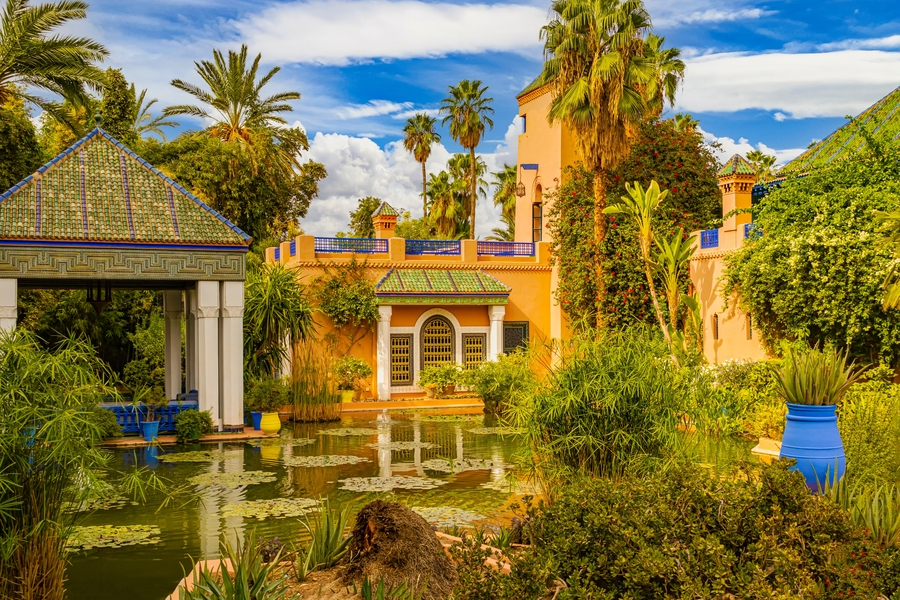
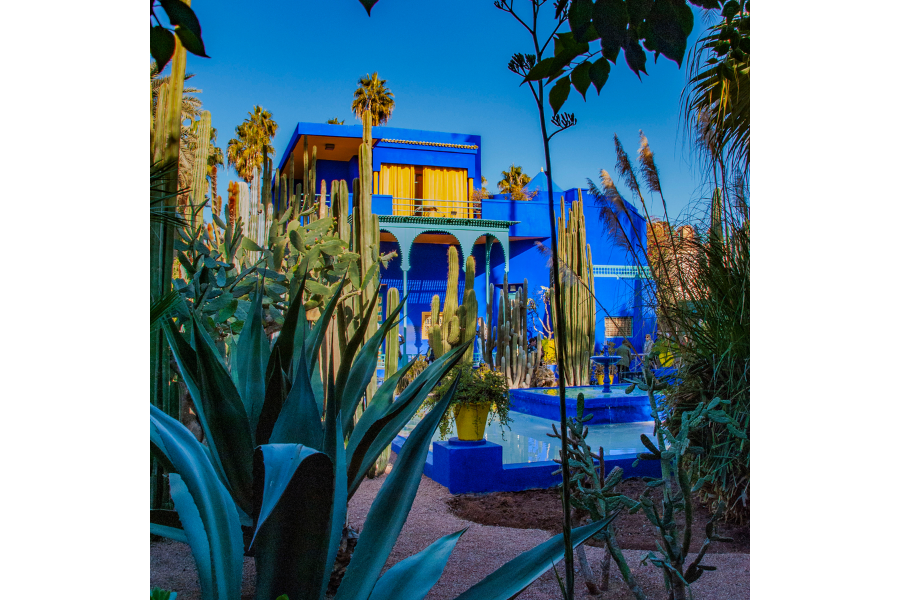
Majorelle travelled, hunted, collected, planted. He brought back cacti from the Americas, lotus and water lilies from Southeast Asia, bamboo and palms and agaves and desert roses, and coaxed them all into a walled tableau of desert-meets-oasis. His villa rose at its heart, Art Deco curves softened by Moroccan craft. And then he did the thing no one had quite done before: he took cobalt oxide, the pigment of laboratory and kiln, and painted nearly every wall, basin and fence with it – a blue so saturated it seems to hum against the green.
Ruin, Rescue, and the Couturier Who Stayed
Majorelle died in 1962; the garden fell to neglect and, by the late seventies, to the threat of developers. Enter the second man. Yves Saint Laurent and Pierre Bergé discovered Marrakech in 1966 and the garden shortly after; when they learned it was for sale in 1980, the couturier wrote back within hours. ‘Save the Majorelle Garden,’ the estate agent was told. They bought it.
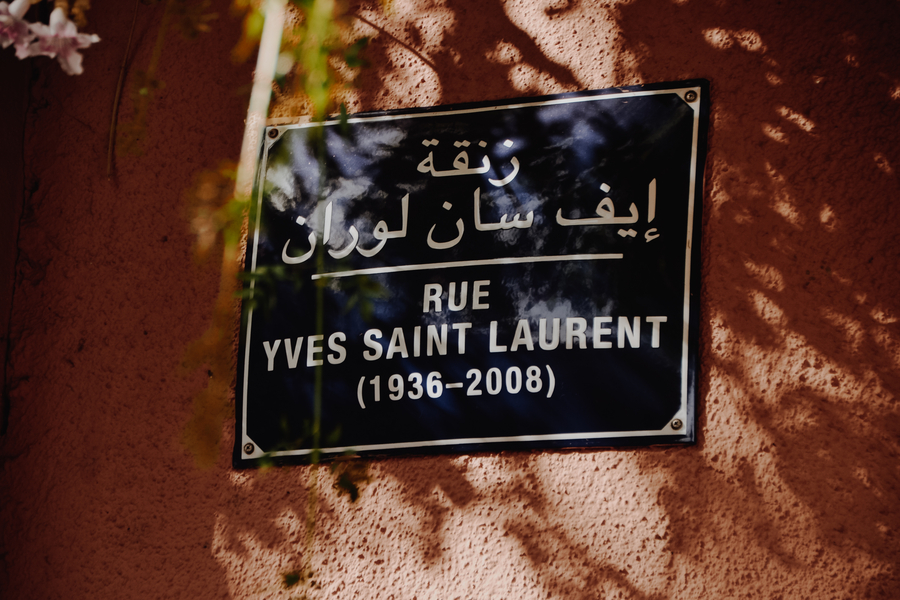
Saint Laurent said it plainly, later: ‘Marrakech taught me colour.’ He and Bergé restored the garden with landscape designer Madison Cox, lived in the Villa Oasis, and for nearly three decades drew strength from the place that stood, in his own telling, at the centre of his artistic life. When he died in 2008, his ashes were scattered in the garden. The city went further: it renamed the street outside Rue Yves Saint Laurent.
The Garden as a Work of Botany
The garden is often photographed and seldom read. Look closer and it is a genuine botanical collection – some 300 species from five continents arranged as desert, jungle and water garden in the space of a few hectares. Cacti collected a century ago now tower over visitor paths; a water lily pond mirrors a tiled pavilion; bamboo corridors screen the wind and the crowds.
What makes it work is the choreography of colour. Majorelle Blue doesn’t just contrast the green – it throws it into sharper relief, the way a frame defines a painting. Yellow pots and turquoise trellises triangulate against the blue and the foliage. Nothing is accidental: each hue is placed to make its neighbours look more vivid. Majorelle understood what Saint Laurent practised harmony is not sameness; it is the tension between opposites, resolved.
A Museum Woven From Brick
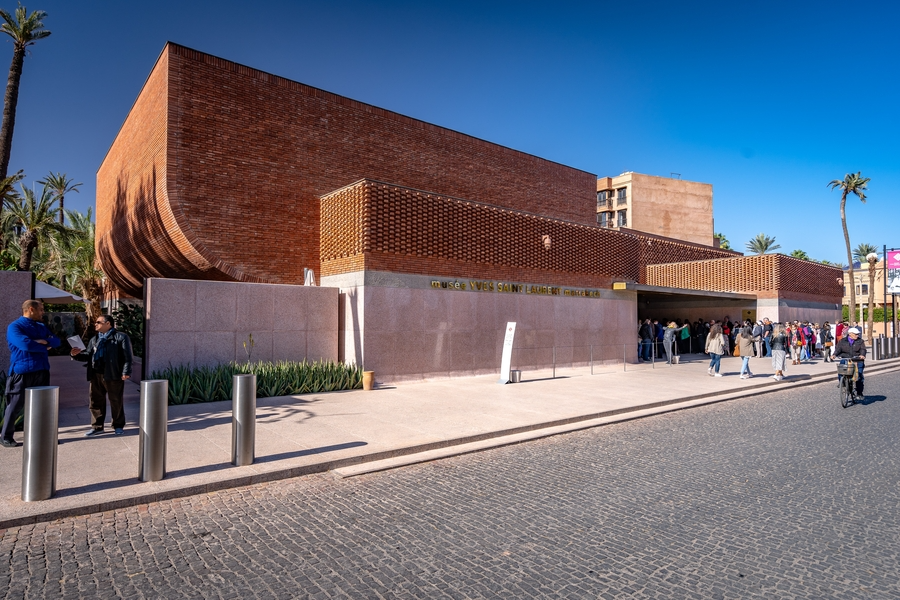
A hundred metres down the same street, the garden gives way to the Musée Yves Saint Laurent Marrakech, opened in October 2017 beside the Fondation Pierre Bergé’s Moroccan home. The building, by Studio KO, speaks couture through masonry: terracotta brick laid in intersecting courses so the facade reads, at the right distance, as the lining of a tweed jacket – warp and weft, thread and weave.
Inside, the monogram greets you at full volume: a gilded YSL against deep blue. There is a permanent gallery, a rotating exhibition space, a research library of five thousand volumes, a bookshop, a café terrace and a 150-seat auditorium.
The permanent collection holds fifty garments from the five thousand couture pieces conserved in Paris – a career in walkable order, from the youthful Trapeze of 1958 through Le Smoking (1966), the safari jacket, the Mondrian dress, and the Africa and Anglomania collections. The clothes are staged beneath projections of Marrakech itself, and the curators’ thesis is unmistakable: this wardrobe was not made about Morocco, it was made by it. Saint Laurent learned colour here; the clothes are the receipts.
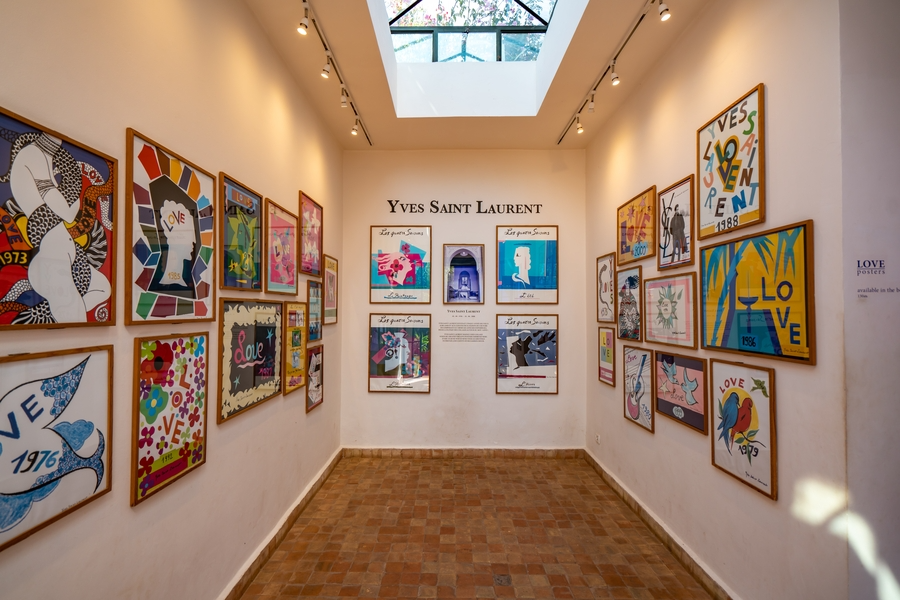
Best of all are the LOVE cards. From 1970 to 2007, every New Year, Saint Laurent mailed his friends a small printed poster that said one word – LOVE – in thirty-eight different voices: blue love, fish-shaped love, tropical love with parrots. A whole gallery of them glows here on white walls beneath a glass-roofed light well. They are the most private art a very public man ever made.
The Colour, Kept
Between museum and garden stands a circular courtyard of pink terrazzo under a radiating brick vault. At its centre, a monolithic slab carries the interlaced YSL monogram; a bronze ring is set in the floor. No screens, nothing to photograph quickly – a small chapel of restraint that asks you to stand still for one minute in front of three letters.
The intensity of that room is the intensity of Majorelle Blue itself: chemically a simple cobalt pigment, but made a place in the world’s imagination by the stubbornness of everyone who chose to keep it. When Bergé’s team restored the garden, there was never a question of another shade. The blue was load-bearing. Remove it and the whole story collapses.
The Garden Remembers
Two men rest near the garden they loved. In a quiet corner shaded by palms, a Roman-style granite column rises from a pink platform beneath a plaque bearing both names – Yves Saint Laurent, 1936-2008, and Pierre Bergé, 1930-2017. It is impossible to stand there and not feel the argument the whole site makes: that beauty, tended properly, outlives its makers. The painter who mixed the pigment is largely forgotten; the couturier is a legend; and yet the blue is still blue. It repaints itself every morning the light touches it.