


















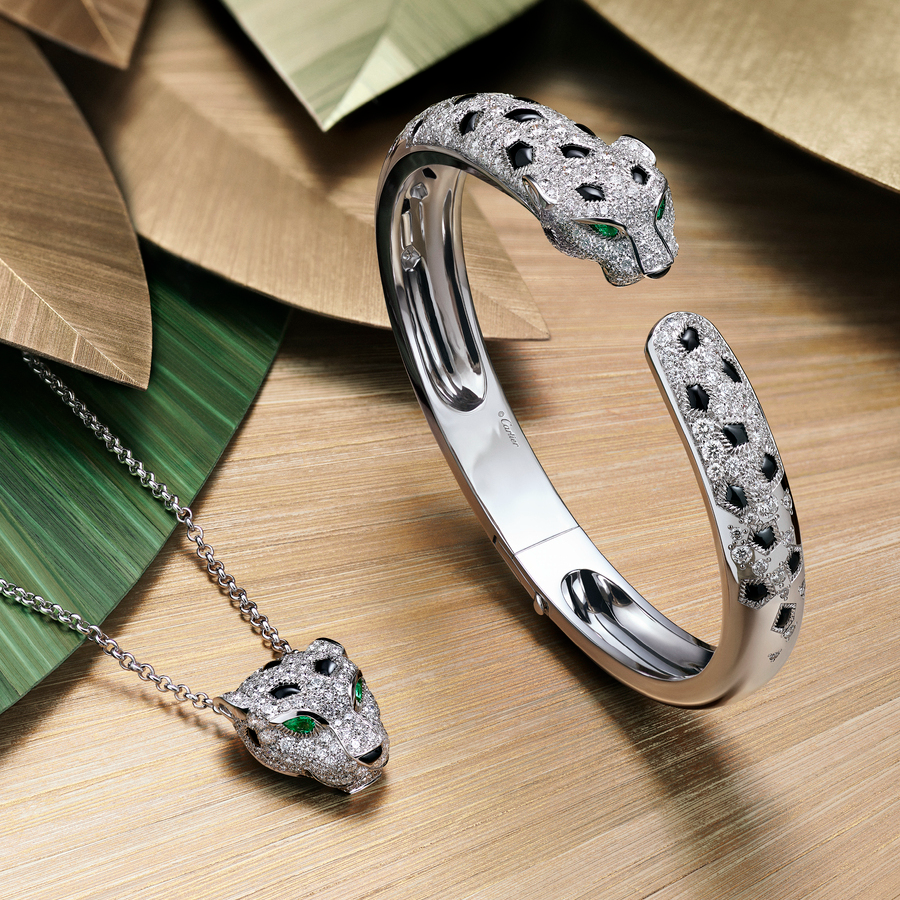
Cartier’s jewelry fauna has held a privileged status from the dawn of the twentieth century, with the introduction of birds and then insects. Then came the first reptiles, felines and chimeras, followed by the zebra and the elephant. This world is populated by magnetic creatures over whom the emblematic Panther reigns, first appearing in her three-dimensional sculptural form in 1948.
It is she who infuses her indomitable aura into this living, ferocious and familiar fauna, whose territories of expression Cartier explores through its latest collections. They perpetuate Cartier’s heritage and pay tribute to the great diversity of unexpected species that make up its animal repertoire. Walking through this gallery of sculptural animal portraits, there are pieces of jewelry with the tiger, parrot, carp, crocodile and rhinoceros. This singular universe contains phenomenal pieces that compete in creativity and precious instinct.
From the Arctic to the tropics, from the seabed to arid lands, Cartier observes nature as closely as possible to its anatomy. This is where the Maison’s métiers come in, from the jeweler to the lapidary, from the gem-setter to the watchmaker, linked by the same adventure. Together, they articulate, sculpt and polish. The pieces come to life, vibrant and sensorial on the skin, like the Panther, who curls up on herself, head to head and entirely covered in a diamond coat. Sometimes she defies space and time, sculpted in the round on the dial of a watch. Each of these animals has its own strength of character, driven by a freedom of spirit that it transmits to all those who carry it.
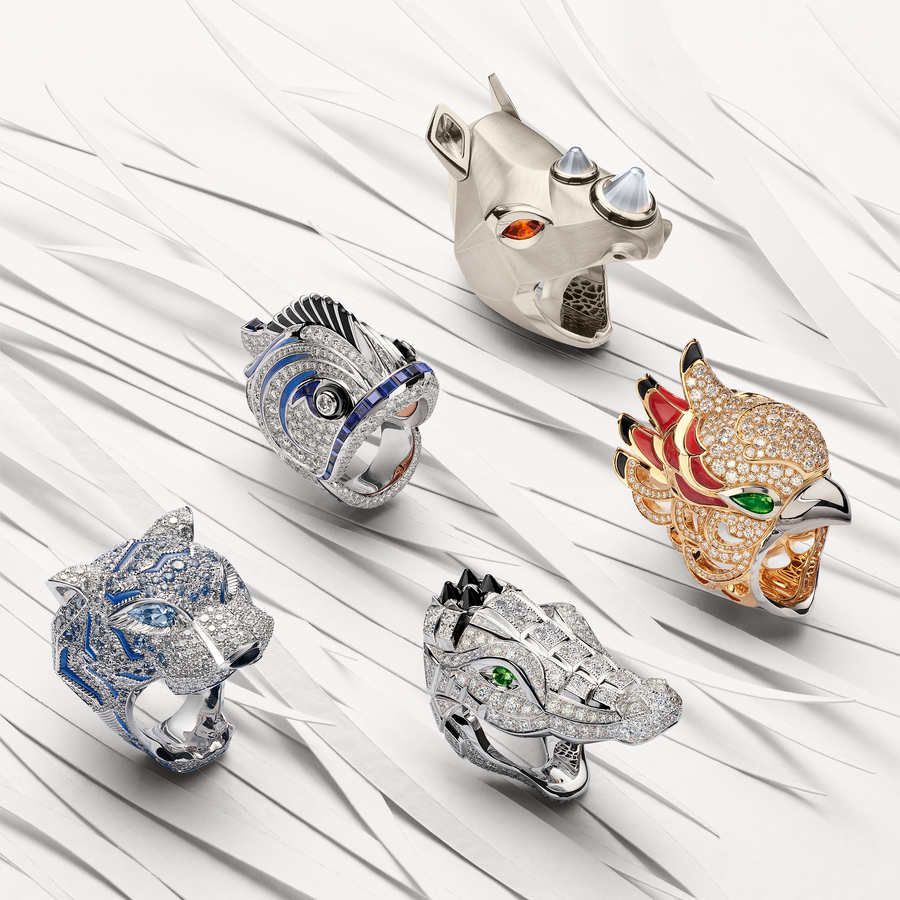
Rings with tiger, parrot, carp, crocodile or rhinoceros heads express themselves with a great blow of the jaw, beak or muzzle. This powerful approach echoes in particular through the Panther head ring created in the 2000s. These stylized heads of strong character meet all the challenges of Cartier savoir-faire. Designers, jewelers, lapidaries and gem-setters have worked to give them this feeling of life, a presence on the hand intensified by their spectacular volume.
From one head to another, Cartier cultivates the art of color contrasts according to one of the Maison’s great historical traditions. There is red and green for the parrot, with coral and tsavorite garnets. There is orange and opaline for the rhinoceros, with spessartite garnet and smoky quartz. Finally, there is white, black and green for the crocodile, with diamonds, onyx spikes and emeralds. This palette of colors sometimes uses shades of blue for the tiger and carp, moving between sapphire, aquamarine and dumortierite quartz.
Created in Cartier’s jewelry workshops, each of these creations is based on a succession of specific skills inherited from Cartier’s long jewelry tradition, which has always focused on representing animals. There is the art of the jeweler, who chisels each head, fuses metals such as the platinum and yellow gold of the parrot, and alternates surfaces of white gold, polished or brushed by hand, for the rhinoceros, as close as possible to its original color.
There are also the paving techniques, true signatures of the Maison, such as fur setting or calibrated sapphires set with rails, which evoke the fur of the tiger, the scales of the crocodile or the edge of the carp’s lips. This multitude of jewelry techniques conveys the impression of wild nature, like the galuchat-effect paving in white diamonds sprinkled with sapphires on the tiger ring, a jewelry metaphor for ice and crystallization.
The expertise of the lapidary is equally essential. It is the lapidary who softens the horns of the rhinoceros in opalescent smoky quartz, highlighted with a line of black lacquer. It is also the lapidary who carves the carp’s dumortierite quartz gills, the parrot’s coral and onyx feather tuft entirely readjusted by hand, and the tiger’s dumortierite quartz stripes.
Beyond appearances, all these finishes contribute to the presence of the animal and the tactility of the jewelry. The crocodile’s articulated jaw encourages the opening of its mouth. White and rose gold alternate to suggest the striated palate of the carp, while the perforation of the inside of the rhinoceros’ mouth echoes the cracked appearance of its skin.
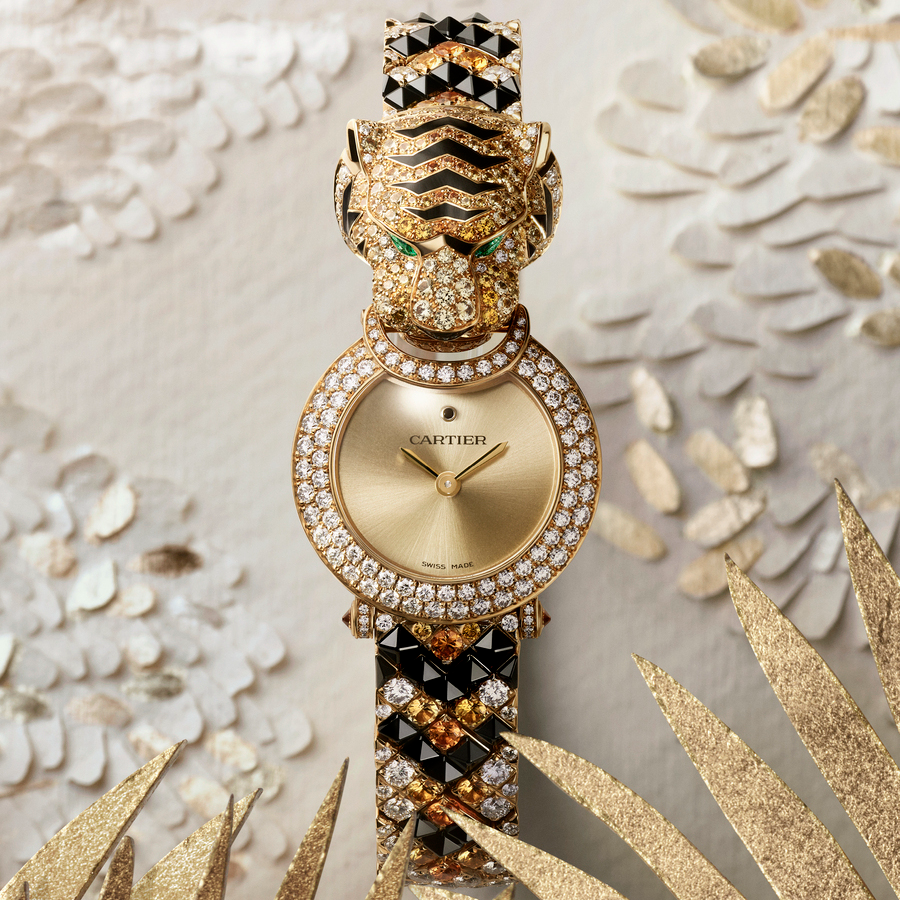
True feats of the atelier, the crocodile and tiger sets evolve between realism and abstraction. On the one hand, the head is made as close as possible to the real anatomy. On the other is the entirely flexible body, for which Cartier has chosen an abstract and graphic motif. These two intentions are driven by a single objective: to restore the living nature of the animal.
The crocodile head clasp cultivates shades of white, green and black, three colors that are part of the Maison’s chromatic heritage, underlining and accentuating contrasts. Fully integrated into the mouth of the animal that bites the back of the bracelet, its ingenious system has been the subject of very special development. This sculptural crocodile head is covered by scales represented by a combination of diamonds whose geometric shapes echo the onyx spikes, an aesthetic code of the Maison, which represent the crocodile’s crest.
The crocodile strap favors rhythm and extreme fluidity, that of a fully articulated structure. Everything must remain mobile and sensorial on the skin, a veritable wave of diamonds set in an inverted setting and punctuated with onyx. This vitality is further accentuated by the cuff’s borders, hemmed with chrysoprase and rubellites.
The tiger head clasp opts for shades of blue: dumortierite quartz for the stripes, sapphire paving for the head and body, and aquamarine for the eyes. Cartier highlights the graphic galuchat-effect setting of the diamonds on this sculptural head. Its opening and closing system, hidden inside the animal’s mouth, required specific development in order to fully integrate the system and avoid any break in the line of the bracelet.
The tiger bracelet features an abstract pattern, a succession of dumortierite quartz and sapphires that rests on a fully articulated gold structure composed of movable links. This movement is further accentuated by the interplay of materials punctuated by chalcedony beads studded with a sapphire in an inverted setting.
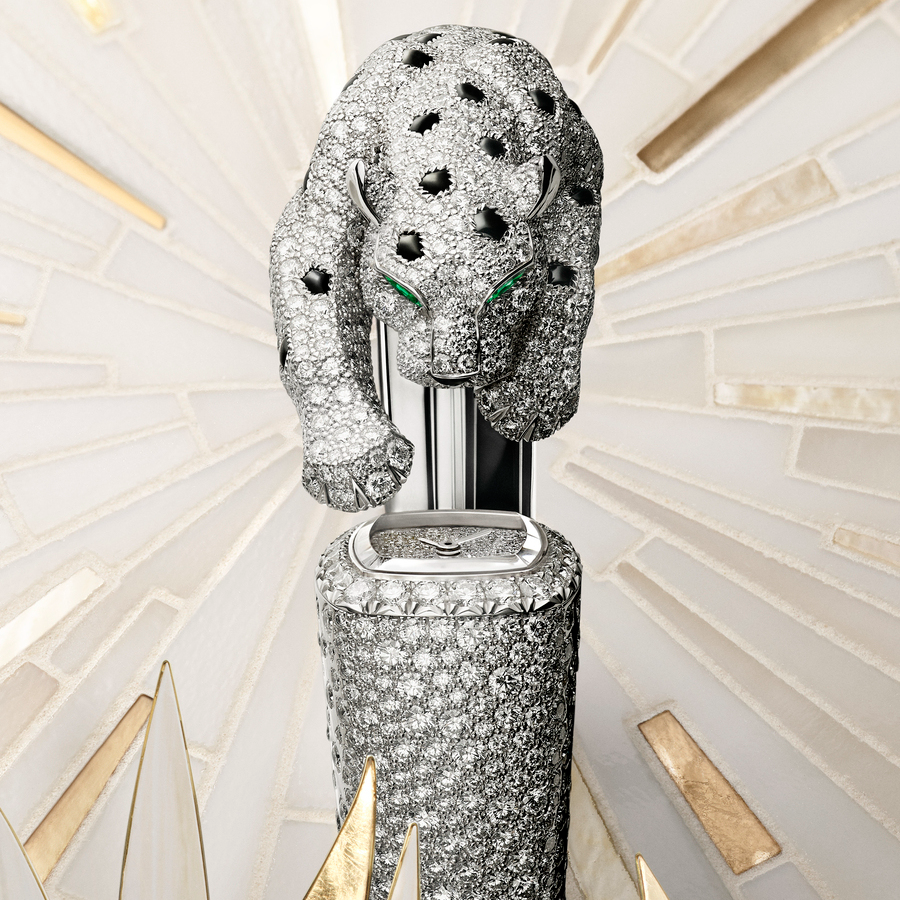
The emblematic Panthère de Cartier tête-à-tête bracelet adopts the immaculate white of a coat entirely paved and spotted with geometric diamonds. This precious new interpretation is based on the alternation of galuchat-effect paving with different diamond sizes and caviar paving that extends the play of light between the paved zones and the white gold structure. Crafted in the great tradition of the Maison’s animal savoir-faire, this snow Panther is endowed with two emerald eyes encircled by a fur setting that evokes the animal’s coat.
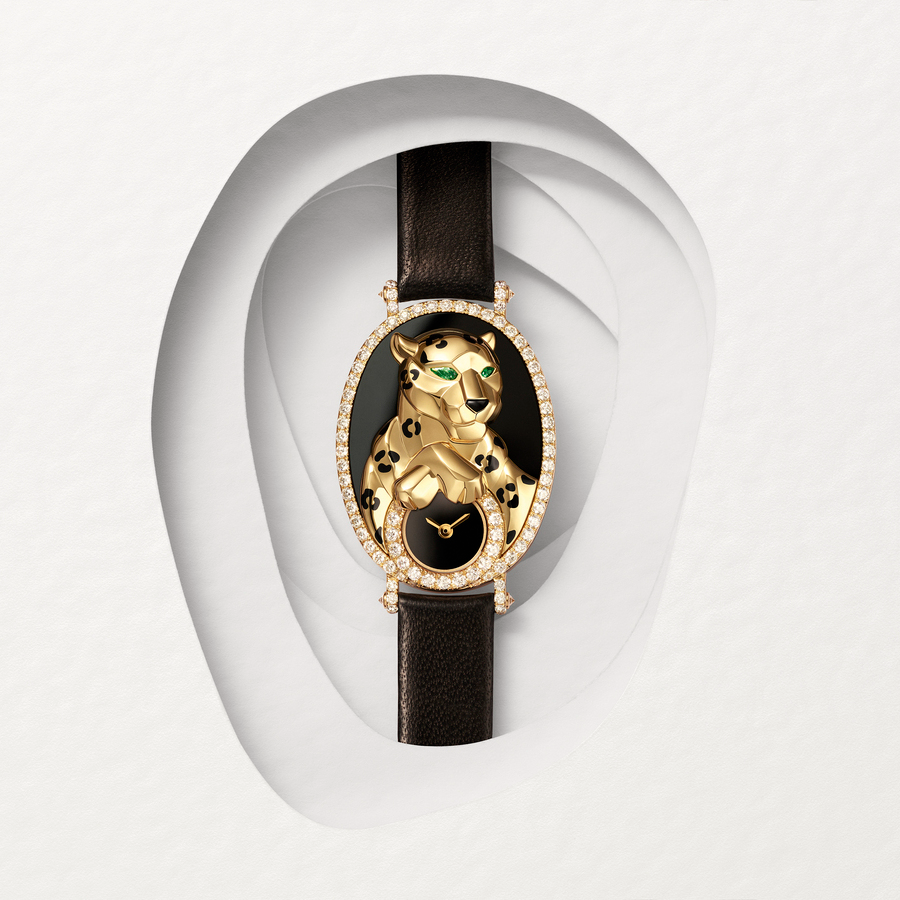
Created by Cartier’s Maison des Métiers d’Art in La Chaux-de-Fonds, Switzerland, an exceptional place dedicated to rare crafts such as enamel or marquetry, the medallion-shaped Panthère jewelry watch is inspired by the ancestral technique of cameos. Its aesthetic required the intervention in unison of three professions. The designer imagines a graphic and expressive sculpture where the magnetic Panther seems to evoke the guardian of time.
The gem-setter’s every gesture contributes to enhancing the brilliance of this true watchmaking portrait by removing the metal in favor of the stones. Onyx forms the nose and dial, tsavorite garnets the eyes, and diamonds the four lugs of the case and its bezel. Finally, the lacquerer’s expertise carries the Panther’s stylized spots into the sublime, inspired by the Maison’s vintage pieces.