


















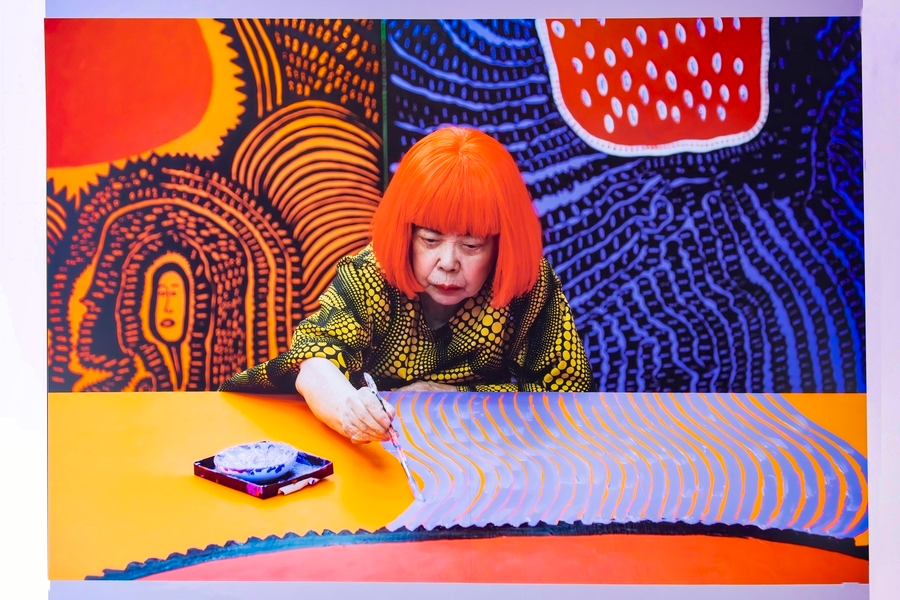
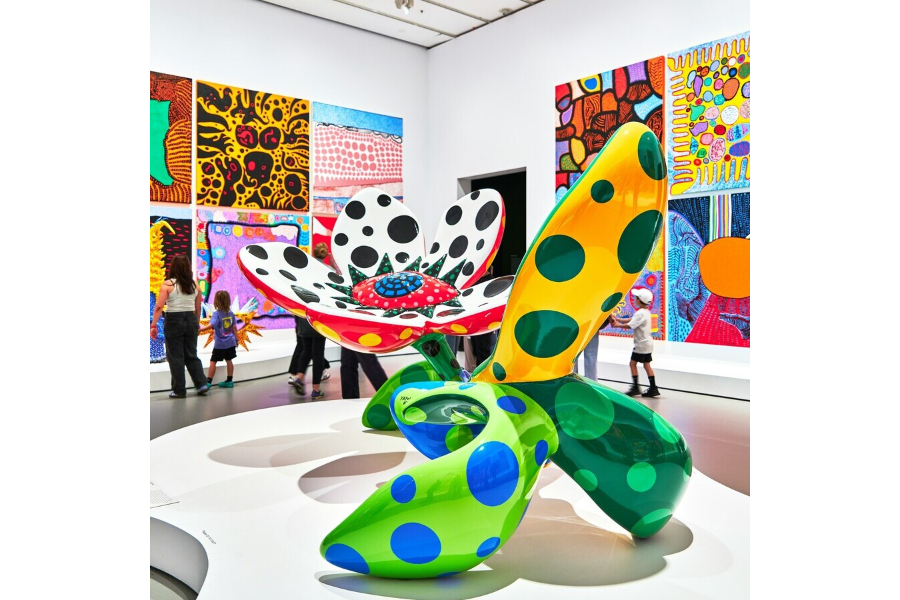
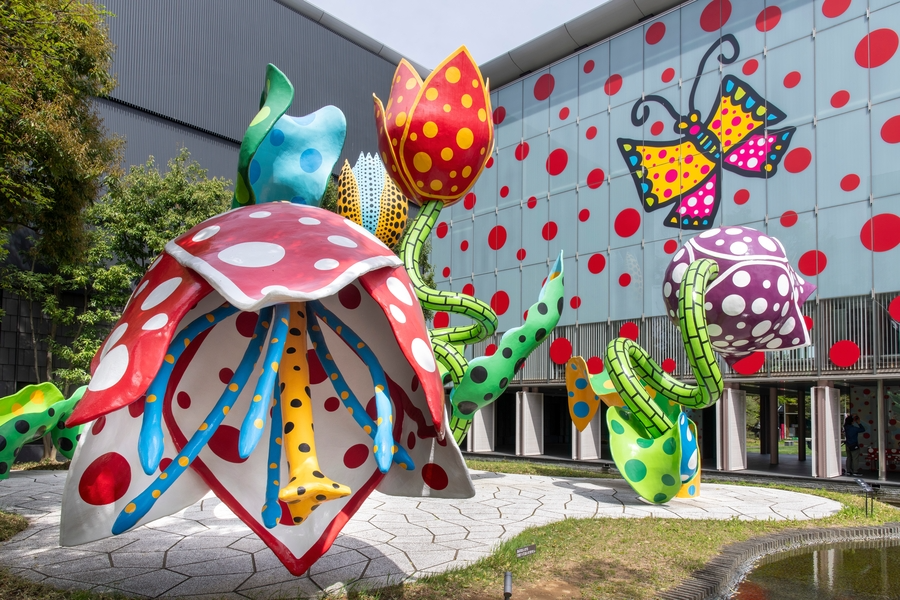
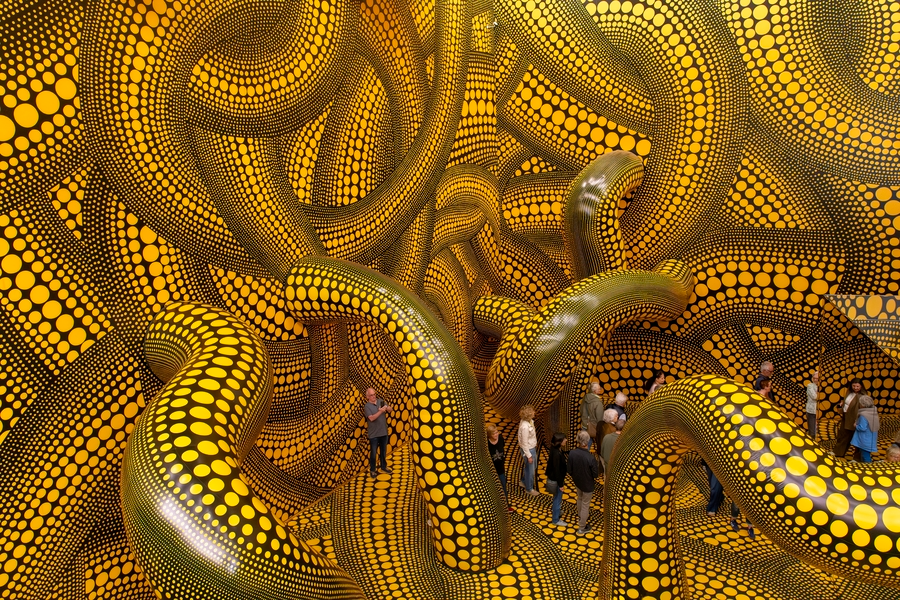
Born on March 22, 1929, Kusama grew up in a prosperous family connected to plant nurseries and seed farming. Her childhood, however, was marked by conflict at home and by hallucinations in which flowers spoke, patterns spread across rooms and her sense of self seemed to disappear. Drawing became a means of translating those experiences into something visible and survivable. Repeated dots and nets were never merely decorative devices. They became the foundations of what she called self-obliteration, a process through which the individual merges with a larger, boundless universe.
That impulse sustained her for more than eight decades. Kusama worked across painting, sculpture, performance, installation, fiction and poetry, moving between rigorous repetition and exuberant color. Her language was immediately recognizable, but never static. The dot could suggest a cell, a planet or a vanishing point; the net could be a veil, a field or an endless structure. In her hands, repetition became both discipline and liberation.
After studying traditional nihonga painting in Kyoto, Kusama became increasingly determined to move beyond its conventions. In the mid-1950s, she wrote to Georgia O’Keeffe, whose address she had found in a book. O’Keeffe replied and encouraged her ambitions. Kusama left Japan in 1957, first traveling to Seattle and then settling in New York the following year. She arrived with limited means, fierce purpose and a body of ideas unlike anything the city’s art establishment was prepared to receive.
Her Infinity Nets announced that vision with quiet intensity. Vast canvases were covered edge to edge with small, looping marks, often painted in white over darker grounds. Without a central subject or fixed point of attention, the works seemed to continue beyond their physical borders. Her 1959 exhibition at Brata Gallery drew the attention of Donald Judd and Frank Stella, yet the wider history of Minimalism did not initially grant her the place her innovations deserved. As a Japanese woman in a male-dominated American art world, she often watched ideas adjacent to her own receive greater recognition in the hands of others.
Kusama responded by pushing beyond the canvas. Her Accumulation works covered furniture, boats, ladders and shoes with hand-sewn fabric forms. In 1965, Infinity Mirror Room: Phalli’s Field used mirrors to multiply a landscape of red-spotted soft sculptures into apparent endlessness. The work established a format that would become central to her legacy, while preserving the psychological tension at the heart of her practice: wonder paired with unease, beauty shadowed by disappearance.
The late 1960s also revealed her instinct for art as public action. She staged body-painting events and anti-war happenings in New York, including demonstrations near prominent civic and cultural sites. She founded a fashion company, published a newspaper and created spaces that challenged accepted ideas around the body, sexuality and social freedom. Long before immersive and participatory art entered the mainstream, Kusama understood that an artwork could surround its audience and implicate them in its meaning.
Exhausted and unwell, Kusama returned to Japan in 1973. Four years later, she voluntarily entered a psychiatric hospital in Tokyo and established a rhythm that would define the rest of her life: she lived at the hospital and worked at a studio nearby. Far from representing retreat from art, this structure enabled an extraordinary continuation. She painted, wrote novels and poetry, and kept refining the motifs that had accompanied her since childhood.
International recognition gathered momentum after a 1989 retrospective in New York. In 1993, Kusama represented Japan at the Venice Biennale with a mirrored environment filled with pumpkins. Major exhibitions at institutions including Tate Modern, the Whitney Museum of American Art and the Centre Pompidou followed. Audiences embraced the Infinity Mirror Rooms, often waiting for hours for a brief solitary encounter inside them. The installations became emblematic of the image-saturated age, yet their origins remained intensely personal. Each offered visitors a carefully constructed version of the perceptual experiences Kusama had spent a lifetime negotiating.
Her pumpkins carried a different warmth. Kusama valued their generous, unpretentious character and remembered them from childhood. The yellow Pumpkin installed on a pier at Naoshima in 1994 became one of her most beloved works, its black dots wrapping a humble garden form in cosmic rhythm. When a typhoon damaged the sculpture in 2021, its return the following year felt less like a replacement than the restoration of a familiar presence.
Other works invited the public to complete the act of transformation. In The Obliteration Room, first realized in 2002, visitors placed colored dot stickers throughout an entirely white domestic interior. As the room accumulated marks, its furniture and boundaries gradually disappeared beneath collective color. Narcissus Garden, first presented without invitation during the 1966 Venice Biennale, spread mirrored spheres across the landscape and turned reflection, repetition and the art market itself into material. Across these works, participation was never an accessory. It was the means by which the self entered the pattern.
Kusama’s late career brought a rare convergence of critical esteem and popular affection. Collaborations with Louis Vuitton carried her motifs into fashion and city streets, while the Yayoi Kusama Museum opened in Tokyo in 2017. Her hometown’s Matsumoto City Museum of Art celebrates her work, and installations in collections around the world ensure that new generations will continue to encounter her vision. She received major honors, yet the deepest measure of her achievement lies in how decisively she expanded the possibilities of contemporary art.
She anticipated Minimalism, Pop, performance and the participatory installation without being contained by any one movement. Her practice joined exacting labor to theatrical spectacle, and psychological vulnerability to formidable control. The familiar red wig and polka-dot clothing became part of an authored public image, but the work itself remained more complex than celebrity. Behind its immediate visual pleasure was sustained inquiry into mortality, identity, fear, love and the scale of human existence.
The official announcement of her passing emphasized that she continued painting until her final days and remained committed to the belief that love could help save the world. That conviction gives her art its lasting generosity. Kusama did not simply reproduce the visions that troubled her. She rebuilt them as spaces others could enter, transforming isolation into a shared experience and private repetition into a global visual language.
Her legacy lives in immense mirrored galaxies, fields of painted nets and pumpkins glowing against sea and sky. It also lives in a quieter moment: a single viewer surrounded by reflections, briefly unable to locate the edge of the room or the boundary of the self. Kusama taught the world to look at a dot and imagine the cosmos. The artist is gone, but the pattern continues, luminous and without end.